In the monotherapy* clinical trials,
Adverse reactions that occurred in ≥3% of patients treated with JUVMO and ≥2% difference from placebo1
TEMPO-1 & TEMPO-2 (27 weeks)
 Pinch to zoom
Adverse
Reaction
Reaction
JUVMO
(N=505)
Placebo
(N=328)
Nausea
27%
2%
Headache†
17%
5%
Dizziness
14%
4%
Fatigue‡
10%
3%
Dysgeusia
8%
0%
Vomiting
7%
<1%
Dry mouth
5%
<1%
Anxiety
5%
2%
Hypotension
4%
1%
Dyspepsia
4%
1%
Abnormal dreams
4%
<1%
Orthostatic hypotension
4%
<1%
Hallucination†
3%
0%
GERD
3%
<1%
Constipation
3%
1%
The majority of AEs were nonserious and mild to moderate in severity.2,3
Treatment discontinuations due to AEs occurred in 19.8% (N=505) of patients taking JUVMO compared with 4.0% on placebo (N=328).2,3
*Across TEMPO-1 and TEMPO-2 clinical trials, 28% of JUVMO patients (n=141/505) were taking MAO-B inhibitors at baseline.2,3
†Includes multiple related terms.1
‡Fatigue includes asthenia.1
NO LABELED WARNINGS AND PRECAUTIONS FOR: DAWS, FALLING ASLEEP DURING ACTIVITIES OF DAILY LIVING, OR SOMNOLENCE
WARNINGS AND PRECAUTIONS INCLUDE HYPOTENSION/ORTHOSTATIC HYPOTENSION, IMPULSE CONTROL/COMPULSIVE BEHAVIORS, HALLUCINATIONS AND PSYCHOTIC-LIKE BEHAVIOR, AND DYSKINESIA.1
Low rates of the following adverse events of interest:
Impulse control disorder1
JUVMO: 1.0%
Placebo: 0%
Somnolence2,3
JUVMO: 3.2%
Placebo: 3.7%
Dyskinesia1
JUVMO: 0.6%
Placebo: 0%
Subgroup analysis
Incidence of the most common adverse events§ generally decreased in the Maintenance Phase after the dose was titrated2,3
of patients who received JUVMO (n=427/505) did not discontinue due to an adverse event in the Titration Phase4
§≥5% incidence in patients treated with JUVMO.2,3
Adverse reactions that occurred in ≥3% of patients treated with JUVMO + oral levodopa and ≥2% difference from placebo + oral levodopa1
Pinch to zoomTEMPO-3 (27 weeks)1
Adverse Reaction
JUVMO + Oral levodopa
(N=251)
Placebo + Oral levodopa
(N=254)
Nausea
14%
4%
Dyskinesia
10%
2%
Dizziness
8%
3%
Headache†
7%
3%
Hallucination†
7%
1%
Orthostatic hypotension
6%
1%
Hypotension
4%
<1%
Abdominal pain
3%
<1%
Asthenia
3%
0%
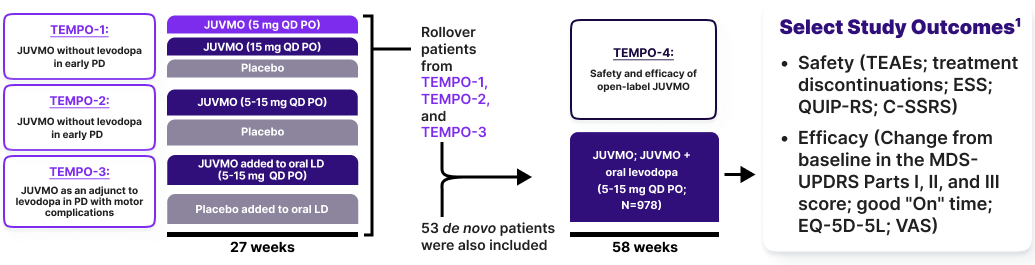
TEMPO-4 (OLE; 85 weeks)5*
JUVMO + Oral levodopa
(N=138)
5.1%
4.3%
5.8%
2.2%
5.8%
2.2%
3.6%
2.9%
0%
The majority of AEs were nonserious and mild to moderate in severity.6
Treatment discontinuations due to AEs occurred in 17.1% (n=43/251) of patients taking JUVMO + oral levodopa and 9.1% (n=23/254) of patients taking placebo + oral levodopa in TEMPO-31,6; 10.9% (n=15/138) of patients taking JUVMO + oral levodopa in the TEMPO-4 OLE discontinued due to AEs.5*
*Data reflect active rollover patients from TEMPO-3.5
†Includes multiple related terms.1
NO LABELED WARNINGS AND PRECAUTIONS FOR: DAWS, FALLING ASLEEP DURING ACTIVITIES OF DAILY LIVING, OR SOMNOLENCE
WARNINGS AND PRECAUTIONS INCLUDE HYPOTENSION/ORTHOSTATIC HYPOTENSION, IMPULSE CONTROL/COMPULSIVE BEHAVIORS, HALLUCINATIONS AND PSYCHOTIC-LIKE BEHAVIOR, AND DYSKINESIA.1
Low rates of the following adverse events of interest at 27 weeks and observed over 85 weeks*
Pinch to zoom| Impulse Control Disorder1 | Somnolence6 | Dyskinesia1 | |
|---|---|---|---|
| Week 27 (TEMPO-3) | JUVMO +
Oral LD: 2.0%
Placebo +
Oral LD: 1.0%
|
JUVMO +
Oral LD: 5.2%
Placebo +
Oral LD: 4.3%
|
JUVMO +
Oral LD: 10.0%
Placebo +
Oral LD: 2.0%
|
Week 85 (TEMPO-4; OLE), all patients on JUVMO5*
99% of patients did not report impulse control disorders
95% of patients did not report somnolence
96% of patients did not report dyskinesia
OLE Limitations: There is potential for enrichment of OLE data; unblinding patients may cause bias related to overall treatment effect; data are descriptive in nature, and findings should be interpreted with caution.
Subgroup analysis
Incidence of the most common adverse events‡ generally decreased in the Maintenance Phase after the dose was titrated6
In the adjunctive clinical trial,
of patients who received JUVMO + oral levodopa (n=223/251) did not discontinue due to an adverse event in the Titration Phase4
‡≥5% incidence in patients treated with JUVMO + oral levodopa.6

AI-generated depiction. Not a real patient.
||Please see Prescribing Information on dose modifications for CYP3A inducers and inhibitors.
AE=adverse event; DAWS=dopamine agonist withdrawal syndrome; GERD=gastroesophageal reflux disease; ICD=impulse control disorder; LD=levodopa; MAO-B=monoamine oxidase-B; OLE=open-label extension.