
AI-generated depiction. Not a real patient.

TEMPO-3 (with oral levodopa)
Patients experienced significantly more good “On” time* with JUVMO added to oral LD vs oral LD alone1,2
Primary endpoint: Change from baseline to week 26 in total daily good "On" time*
 Pinch to zoom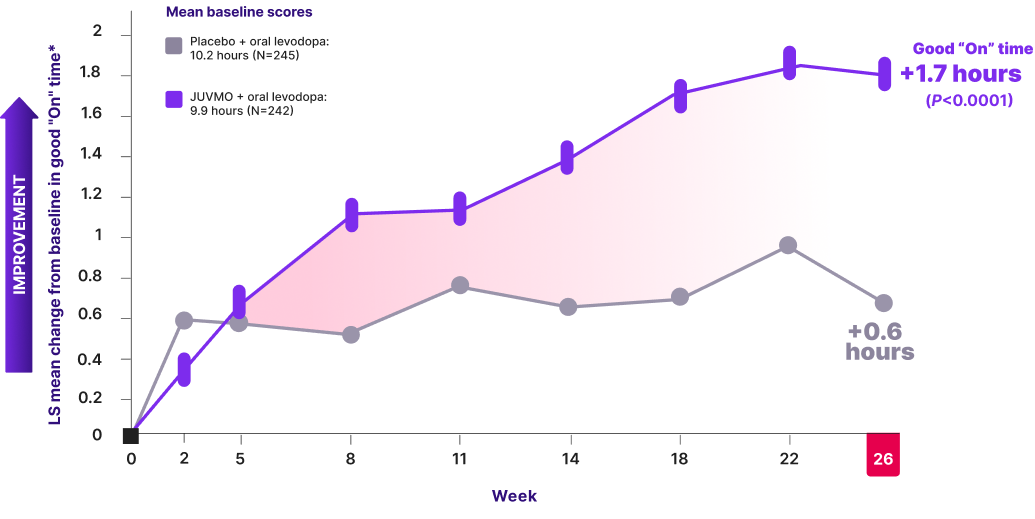
TEMPO-3: Phase 3, randomized, double-blind, placebo-controlled, parallel-group, flexible-dose, 27-week trial in 507 patients with PD experiencing motor fluctuations.1,2
*Good "On" time is defined as "On" time without troublesome dyskinesia (based on the 2-day average of the self-completed Hauser diary).1,2
Post hoc analysis (TEMPO-3)
Mean change in “On” time with no dyskinesia3
LS mean change from baseline to week 26
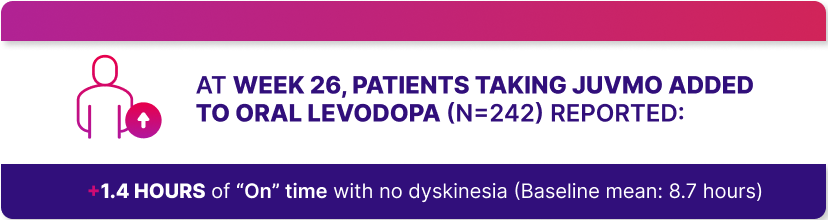
Data Limitations: Data are from a post hoc analysis and are not adjusted for multiplicity; no conclusions of statistical significance can be drawn due to the exploratory nature of the analysis.
Long-term OLE (TEMPO-4)
Proportion of patients who did not increase their oral levodopa dose after 85 weeks4
TEMPO-4: Phase 3, open-label, 58-week trial of patients with PD who completed TEMPO-3.5
OLE Limitations: There is potential for enrichment of OLE data; unblinding patients may cause bias related to overall treatment effect; data are descriptive in nature, and findings should be interpreted with caution.
These data represent patients who rolled over from TEMPO-3. Patients were on a fixed dose of oral levodopa for the first 27 weeks in TEMPO-3.
TEMPO-3 & TEMPO-4 (with oral levodopa)
Durable good "On" time* through 85 weeks on JUVMO + oral levodopa1,2,4
Pinch to zoom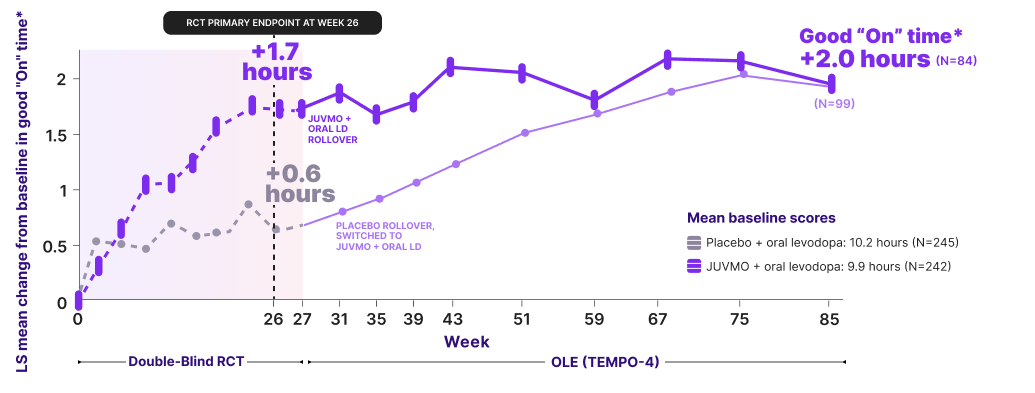
In the RCT, analyses used the mITT population: randomized subjects with ≥1 dose of study drug and both baseline and postbaseline assessments. In the OLE, analyses used the FAS population: subjects with ≥1 dose of study drug.1,4,6
TEMPO-4: Phase 3, open-label, 58-week trial of patients with PD who completed TEMPO-3.5
OLE Limitations: There is potential for enrichment of OLE data; unblinding patients may cause bias related to overall treatment effect; data are descriptive in nature, and findings should be interpreted with caution.
*Good "On" time is defined as "On" time without troublesome dyskinesia (based on the 2-day average of the self-completed Hauser diary).1,2

AI-generated depiction. Not a real patient.
Find out how to get your patients started on JUVMO today
Post hoc analysis (TEMPO-3 & TEMPO-4)
Continuous hours of good “On” time* per day3
Pinch to zoom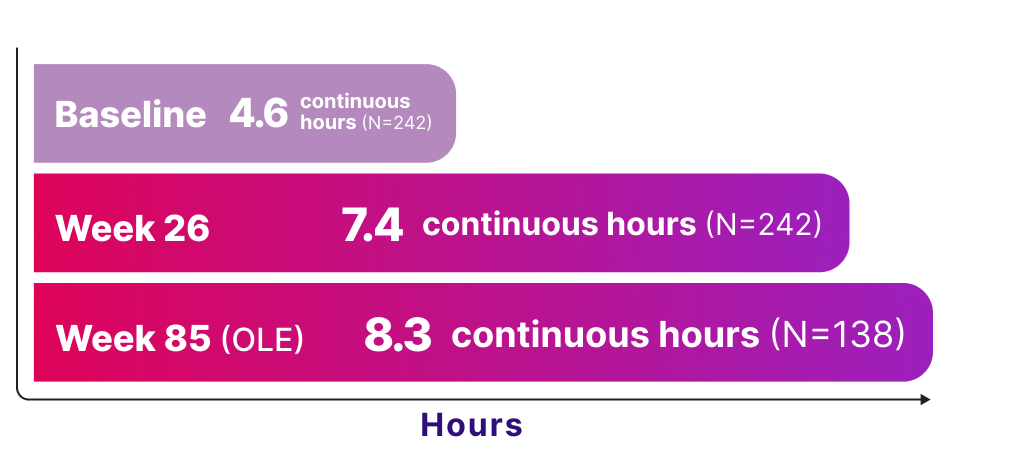
Continuous good “On” time for placebo + oral levodopa at baseline and week 26 were 4.7 hours and 6.8 hours, respectively.3
Data Limitations: Data are from a post hoc analysis and are not adjusted for multiplicity; no conclusions of statistical significance can be drawn due to the exploratory nature of the analysis.
OLE Limitations: There is potential for enrichment of OLE data; unblinding patients may cause bias related to overall treatment effect; data are descriptive in nature, and findings should be interpreted with caution.
*Continuous “On” time defined as the longest stretch of time during the 16-hour waking day during which patients experienced “On” time without troublesome dyskinesia (good).3
TEMPO-4 (with oral levodopa)
Proportion of patients who did not increase their oral levodopa dose after 85 weeks4
In an open-label extension study, an observed
93%
of patients taking JUVMO + oral levodopa did not increase their oral levodopa dose after 85 weeks (n=96/103)
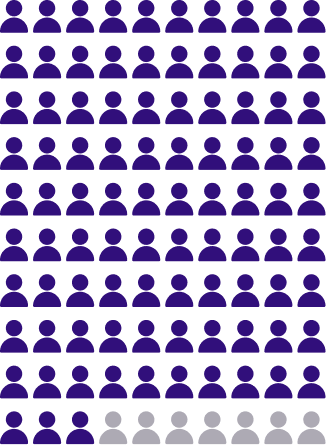
These data represent patients rolled over from TEMPO-3. Patients were on a fixed dose of oral levodopa for the first 27 weeks in TEMPO-3.
TEMPO-4: Phase 3, open-label, 58-week trial of patients with PD including those who completed TEMPO-3.5
OLE Limitations: There is potential for enrichment of OLE data; unblinding patients may cause bias related to overall treatment effect; data are descriptive in nature, and findings should be interpreted with caution.
AI-generated depiction. Not a real patient.
FAS=full analysis set; LD=levodopa; LS=least squares; mITT=modified intent-to-treat; OLE=open-label extension; PD=Parkinson’s disease; RCT=randomized controlled trial.
Hypotension/Orthostatic Hypotension: Patients with Parkinson's disease may have an impaired capacity to respond to an orthostatic challenge. In clinical studies and clinical experience, dopaminergic medications appear to impair the systemic regulation of blood pressure, resulting in hypotension and/or orthostatic hypotension, especially during dose escalation. Patients with PD treated with JUVMO (tavapadon) should be monitored for signs and symptoms of hypotension/orthostatic hypotension, especially during dose escalation, and should be informed of this risk.
Impulse Control/Compulsive Behaviors: Patients may experience intense urges while on JUVMO. Because patients may not recognize these behaviors as abnormal, it is important for prescribers to ask patients or their caregivers specifically about the development of new or increased gambling urges, sexual urges, uncontrolled spending, binge or compulsive eating, or other urges while on JUVMO. Consider reducing the dose or discontinuing JUVMO if a patient develops such urges.
Hallucinations and Psychotic-like Behavior: Medications for the treatment of PD, including JUVMO, can have effects on thinking and behavior. Age appears to increase the risk of hallucinations in patients taking JUVMO. The risk of hallucination may be increased when JUVMO is co-administered with strong CYP3A inhibitors during the maintenance phase. Consider the risks and benefits prior to initiating treatment with JUVMO in patients with a major psychotic disorder because of the risk of exacerbating psychosis. Consider stopping JUVMO if hallucinations or psychotic-like behaviors occur.
Dyskinesia: JUVMO may cause or exacerbate pre-existing dyskinesia. Consider decreasing the dosage of JUVMO or other dopaminergic medications if dyskinesia occurs.
The most common adverse reactions (≥5%) for JUVMO without levodopa were nausea, headache, dizziness, fatigue, dysgeusia, vomiting, dry mouth, and anxiety.
The most common adverse reactions (≥5%) for JUVMO with levodopa were nausea, dyskinesia, dizziness, headache, hallucinations, and orthostatic hypotension.
Strong CYP3A Inducers: Avoid use with JUVMO. Strong and moderate CYP3A inhibitors: avoid use with JUVMO during titration; JUVMO dosage modification is recommended during maintenance. Moderate CYP3A Inducers: JUVMO dosage modification is recommended during titration and maintenance. Consult the full Prescribing Information for JUVMO for more information on drug interactions and recommended dosage modifications.
JUVMO is available as 5 mg, 10 mg, and 15 mg tablets, as well as 0.25 mg and 1 mg tablets contained in a Titration Pack.
Please see full Prescribing Information.
JUVMO is indicated for the treatment of Parkinson’s disease in adults.
US-TAV-260171
TEMPO-1 study design and eligibility1-3
Phase 3, double-blind, randomized, placebo-controlled, 27-week trial to evaluate the efficacy, safety, and tolerability of 2 fixed doses* of JUVMO as monotherapy† in early Parkinson's disease
for 27 weeks






Efficacy Measure
Change from baseline to week 26 in MDS-UPDRS Part II score
Select secondary endpoints included patient impression (eg, PGIC) and safety measures (eg, ESS, QUIP-RS, C-SSRS, and TEAEs). Additional endpoints included change in MDS-UPDRS Part III and MDS-UPDRS Parts II and III combined score.
Select Inclusion Criteria1,2
Select Exclusion Criteria3
*All participants were titrated to the randomized dose through an 8- or 10-step titration schedule for the 5 mg and 15 mg cohorts, respectively (Step 1: 0.25 mg; Step 2: 0.5 mg; Step 3: 0.75 mg; Step 4: 1 mg; Step 5: 1.5 mg; Step 6: 2.25 mg; Step 7: 3 mg; Step 8: 5 mg; Step 9: 10 mg; Step 10: 15 mg). No deviations through Step 8 were allowed; participants unable to tolerate Step 10 could go back to Step 9 and were allowed a one-time rechallenge back to Step 10 if needed for symptomatic control; individuals unable to tolerate the Step 10 dose at rechallenge were discontinued.3
†Concomitant use of MAO-B inhibitors was allowed if started >90 days before baseline.2
C-SSRS=Columbia-Suicide Severity Rating Scale; ESS=Epworth Sleepiness Scale; ICD=impulse control disorder; LD/DAs=levodopa/dopamine agonists; MAO-B=monoamine oxidase-B; MDS-UPDRS=Movement Disorder Society-Unified Parkinson’s Disease Rating Scale; MoCA=Montreal Cognitive Assessment; PD=Parkinson's disease; PGIC=Patient Global Impression of Change; PO=by mouth; QD=once daily; QUIP-RS=Questionnaire for Impulsive-Compulsive Disorders in Parkinson’s Disease-Rating Scale; TEAE=treatment-emergent adverse event.
TEMPO-2 study design and eligibility1-3
Phase 3, double-blind, randomized, placebo-controlled, 27-week trial to evaluate the efficacy, safety, and tolerability of flexible doses* of JUVMO as monotherapy† in early Parkinson's disease
for 27 weeks
Efficacy Measure
Change from baseline to week 26 in MDS-UPDRS Part II score
Select secondary endpoints included patient impression (eg, PGIC) and safety measures (eg, ESS, QUIP-RS, C-SSRS, SMWQ, and TEAEs). Additional endpoints included change in MDS-UPDRS Part III and MDS-UPDRS Parts II and III combined score.
Select Inclusion Criteria1,2
Select Exclusion Criteria3
*Participants received a dose titrated up to 15 mg QD PO, based on individual participant tolerability, through a Titration Phase (Step 1: 0.25 mg; Step 2: 0.5 mg; Step 3: 0.75 mg; Step 4: 1 mg; Step 5: 1.5 mg; Step 6: 2.25 mg; Step 7: 3 mg; Step 8: 5 mg; Step 9: 10 mg; Step 10: 15 mg; Step 11: maximum tolerated dose [5-15 mg]). No deviations through Step 8 were allowed; during the Maintenance Phase, participants continued to receive the highest tolerated dose achieved.3
†Concomitant use of MAO-B inhibitors was allowed if started >90 days before baseline.2
C-SSRS=Columbia-Suicide Severity Rating Scale; ESS=Epworth Sleepiness Scale; ICD=impulse control disorder; LD/DAs=levodopa/dopamine agonists; MAO-B=monoamine oxidase-B; MDS-UPDRS=Movement Disorder Society-Unified Parkinson’s Disease Rating Scale; MoCA=Montreal Cognitive Assessment; PD=Parkinson's disease; PGIC=Patient Global Impression of Change; PO=by mouth; QD=once daily; QUIP-RS=Questionnaire for Impulsive-Compulsive Disorders in Parkinson’s Disease-Rating Scale; SMWQ=Study Medication Withdrawal Questionnaire; TEAE=treatment-emergent adverse event.
TEMPO-3 study design and eligibility1,2
Phase 3, double-blind, randomized, placebo-controlled, parallel-group, flexible-dose,* 27-week trial to evaluate the efficacy, safety, and tolerability of JUVMO in patients with PD experiencing motor fluctuations
for 27 weeks
Primary Endpoint
Change from baseline to week 26 in total “On” time without troublesome dyskinesia (normalized to a 24-hour day)
Select secondary endpoints included change from baseline in total daily “On” time and “Off” time and change from baseline in the MDS-UPDRS Parts I, II, and III individual scores.
Select Inclusion Criteria1,2
Select Exclusion Criteria1,3
*Participants received a dose titrated up to 15 mg QD PO, based on individual participant tolerability through a Titration Phase (Step 1: 0.25 mg; Step 2: 0.5 mg; Step 3: 0.75 mg; Step 4: 1 mg; Step 5: 1.5 mg; Step 6: 2.25 mg; Step 7: 3 mg; Step 8: 5 mg; Step 9: 10 mg; Step 10: 15 mg; Step 11: maximum tolerated dose [5-15 mg]). No deviations through Step 8 were allowed; during the Maintenance Phase, participants will receive the highest tolerated dose achieved.3
COMT=catechol-O-methyltransferase; ICD=impulse control disorder; LD=levodopa; MAO-B=monoamine oxidase-B; MDS-UPDRS=Movement Disorder Society-Unified Parkinson's Disease Rating Scale; MoCA=Montreal Cognitive Assessment; PD=Parkinson's disease; PO=by mouth; QD=once daily.
TEMPO-4 open-label extension study design and eligibility1,2
Phase 3, 58-week, open-label, flexible-dose trial of JUVMO in Parkinson's disease1,2
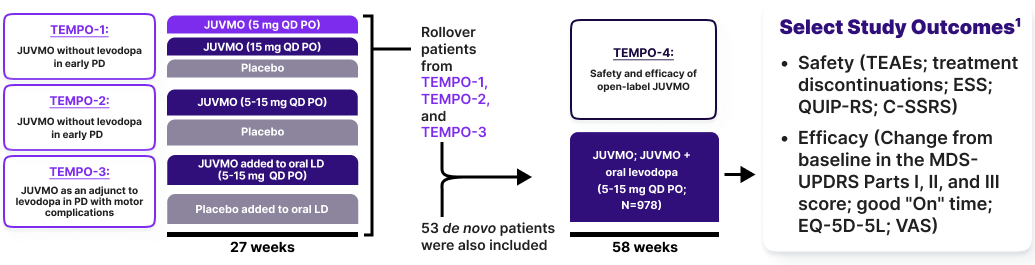
Select Inclusion Criteria1,2
Select Exclusion Criteria1
C-SSRS=Columbia-Suicide Severity Rating Scale; CD/LD=carbidopa/levodopa; EQ-5D-5L=EuroQol 5 Dimension 5 Level; ESS=Epworth Sleepiness Scale; MDS-UPDRS=Movement Disorder Society-Unified Parkinson’s Disease Rating Scale; PD=Parkinson's disease; PO=by mouth; QD=once daily; QUIP-RS=Questionnaire for Impulsive-Compulsive Disorders in Parkinson’s Disease-Rating Scale; TEAE=treatment-emergent adverse event; VAS=visual analog scale.
TEMPO-1 baseline characteristics1
TEMPO-1 (N=529)
Pinch to zoomJUVMO 5 mg
(n=177)
|
JUVMO 15 mg
(n=177)
|
Placebo
(n=175)
|
|
|---|---|---|---|
| Age (years), Mean (SD) | 63.7 (9.8) | 63.8 (9.4) | 63.5 (9.6) |
| Age Group, n (%) | |||
| <65 years | 48.0% | 46.9% | 49.1% |
| ≥65 years | 52.0% | 53.1% | 50.9% |
| Years Since Initial Diagnosis, Mean (SD) | 0.75 (0.84) | 0.76 (0.80) | 0.69 (0.77) |
| Baseline MDS-UPDRS Score, Mean (SD) | |||
| Part II | 7.1 (4.0) | 7.7 (4.2) | 7.4 (3.8) |
| Part III | 24.1 (8.6) | 24.3 (9.1) | 24.7 (8.1) |
| Parts II + III | 31.3 (10.9) | 32.1 (11.6) | 32.0 (10.0) |
| MAO-B Inhibitor Use at Baseline | 26.6% | 27.1% | 24.0% |
MAO-B=monoamine oxidase-B; MDS-UPDRS=Movement Disorder Society-Unified Parkinson’s Disease Rating Scale; SD=standard deviation.
TEMPO-2 baseline characteristics1
TEMPO-2 (N=304)
Pinch to zoomJUVMO 5-15 mg
(n=151)
|
Placebo
(n=153)
|
|
|---|---|---|
| Age (years), Mean (SD) | 63.1 (9.0) | 62.6 (9.4) |
| Age Group, n (%) | ||
| <65 years | 51% | 54% |
| ≥65 years | 49% | 46% |
| Years Since Initial Diagnosis, Mean (SD) | 0.88 (0.78) | 0.85 (0.81) |
| Baseline MDS-UPDRS Score, Mean (SD) | ||
| Part II | 7.4 (4.3) | 6.9 (3.9) |
| Part III | 23.6 (8.8) | 23.1 (8.9) |
| Parts II + III | 31.1 (11.2) | 30.0 (11.1) |
| MAO-B Inhibitor Use at Baseline | 30.5% | 29.4% |
MAO-B=monoamine oxidase-B; MDS-UPDRS=Movement Disorder Society-Unified Parkinson’s Disease Rating Scale; SD=standard deviation.
TEMPO-3 baseline characteristics1
TEMPO-3 (N=507)
Pinch to zoomJUVMO 5-15 mg
(N=252)
|
Placebo
(N=255)
|
|
|---|---|---|
| Age (years), Mean (SD) | 65.6 (8.4) | 64.1 (8.5) |
| Age Group, n (%) | ||
| <65 years | 41.3% | 46.7% |
| ≥65 years | 58.7% | 53.3% |
| Years Since Initial Diagnosis, Mean (SD) | 6.9 (4.5) | 6.4 (4.6) |
| Baseline MDS-UPDRS Part II Score, Mean (SD) | 13.3 (6.5) | 12.5 (7.1) |
| Daily LD dose (mg), Mean (SD) | 811.9 (451.4) | 817.6 (644.0) |
| Daily “On” time without troublesome dyskinesia (hours), Mean (SD) | 9.9 (2.6) | 10.1 (2.6) |
| Daily “Off” time (hours), Mean (SD) | 5.6 (2.2) | 5.4 (2.5) |
LD=levodopa; MDS-UPDRS=Movement Disorder Society-Unified Parkinson’s Disease Rating Scale; SD=standard deviation.